
A data-driven sculpture on invasive alien species that pushes you out of your ecosystem.

Invasiva is a new ecological artwork by Thijs Biersteker, woven in collaboration with Fauna & Flora about the impact of invasive alien species on their ecosystems.
The giant intricately detailed inflatable sculpture physically pushes visitors out of the room, just like invasive alien species push out native ecosystems.

Driven by data, and informed by expertise from Fauna & Flora and IUCN, the artwork INVASIVA inflates and deflates in a data driven rhythm.
As visitors read the surrounding facts on the impact of fire ants or water hyacints, the work grows, crowds them, and pushes them aside.
They become the native species being pushed out of their own ecosystem.
Then it deflates inward, folds back into its footprint, and offers something rarer than urgency. Hope.
Invasiva pushes visitors out of their own ecosystem, just like invasive alien species do.
Premiering at the World Biodiversity Forum and traveling to the CBD COP in Armenia as the central artwork, Invasiva sets out to let invasive alien species invade the global agenda.
Ecological artist Thijs Biersteker, in collaboration with Fauna & Flora, the Villars Institute, the World Biodiversity Forum, and the IUCN, presents Invasiva, a 4.5 meter woven sculpture that inflates and deflates on invasive alien species data.
The installation physically pushes visitors out of the room to give them the bodily experience of what invasive alien species do to native ecosystems every day. Invasive alien species are among the top five drivers of biodiversity loss worldwide. According to the IPBES 2023 assessment, they have contributed to 60 percent of recorded global extinctions and cost the global economy more than $423 billion every year. Those costs have at least quadrupled every decade since 1970.
Invasive alien species are spread mostly by ordinary human activity, through trade, tourism, and accidental introduction. The science is clear. The agency to act is missing.
Invasiva is a fully woven, hand-drawn, data-driven inflatable sculpture. Its sphere is a single composition of some of the world's most ecologically damaging invasive alien species, identified by the IUCN Invasive Species Specialist Group and IPBES, illustrated and woven into the artwork together. Water hyacinth alongside black rat. Feral cat next to zebra mussel. Water, land, and air species threaded into a single skin, showing that there is no villain in this work. These species are simply out of place.
Driven by global invasive alien species impact data, past, present, and projected twenty years into the future, the sculpture inflates over roughly ten minutes. As visitors read facts on the surrounding walls and interactive panels, the work grows. It crowds them. It pushes them aside. They slowly feel the uncomfortable truth that they themselves are being pushed out of their ecosystem.
Then the sculpture deflates inward, folding back into its own footprint. The deflation is deliberate. It is a gesture of hope. The spread of invasive alien species is solvable, and this is one of the few biodiversity crises where action is genuinely possible.
The work was born out of a heated conversation at the CBD COP in Colombia between Biersteker, Lee Howell of the Villars Institute, and Kristian Teleki, CEO of Fauna & Flora.
"Lee told me I thought I knew about invasive alien species, but I had no idea of the actual scale," says Biersteker. "Once Kristian explained its complexity, it clicked. This is one of the most tangible and most actionable parts of the biodiversity crisis. It deserved to invade the global imagination."
A pivotal moment came at the Villars Institute, when youth fellows from across the globe independently named the water hyacinth as the invasive alien species choking the waters of their home countries. From Sri Lanka to Africa to Europe, the same beautiful plant, the same suffocating problem.
Produced by Woven Studio, founded by Thijs Biersteker and Sophie de Krom. Scientific guidance from Fauna & Flora and IUCN, including Kevin Smith (Head of Programme, Invasive Species and Wildlife Health at IUCN), Libby Sandbrook (Director of Business & Nature at Fauna & Flora), and Halley Rose Meslin of Fauna & Flora.
Illustrations hand-drawn by Biersteker, translated into woven cloth by EE Labels (Dutch heritage atelier since 1900). Publiair guided the inflation system. Support from the Villars Institute, World Biodiversity Forum, IUCN, and CBD.
Invasiva premieres at the World Biodiversity Forum and travels to the CBD COP in Armenia. An education module, The Invaders, has been developed with the Villars Institute.
Learn more"After being pushed out of their own ecosystem, visitors leave with a memory in their body. That is what changes how they talk to their teams, their governments, and their neighbors. My job is to reach the heads of state and the hearts of the people. Invasiva is the campfire where that conversation begins."
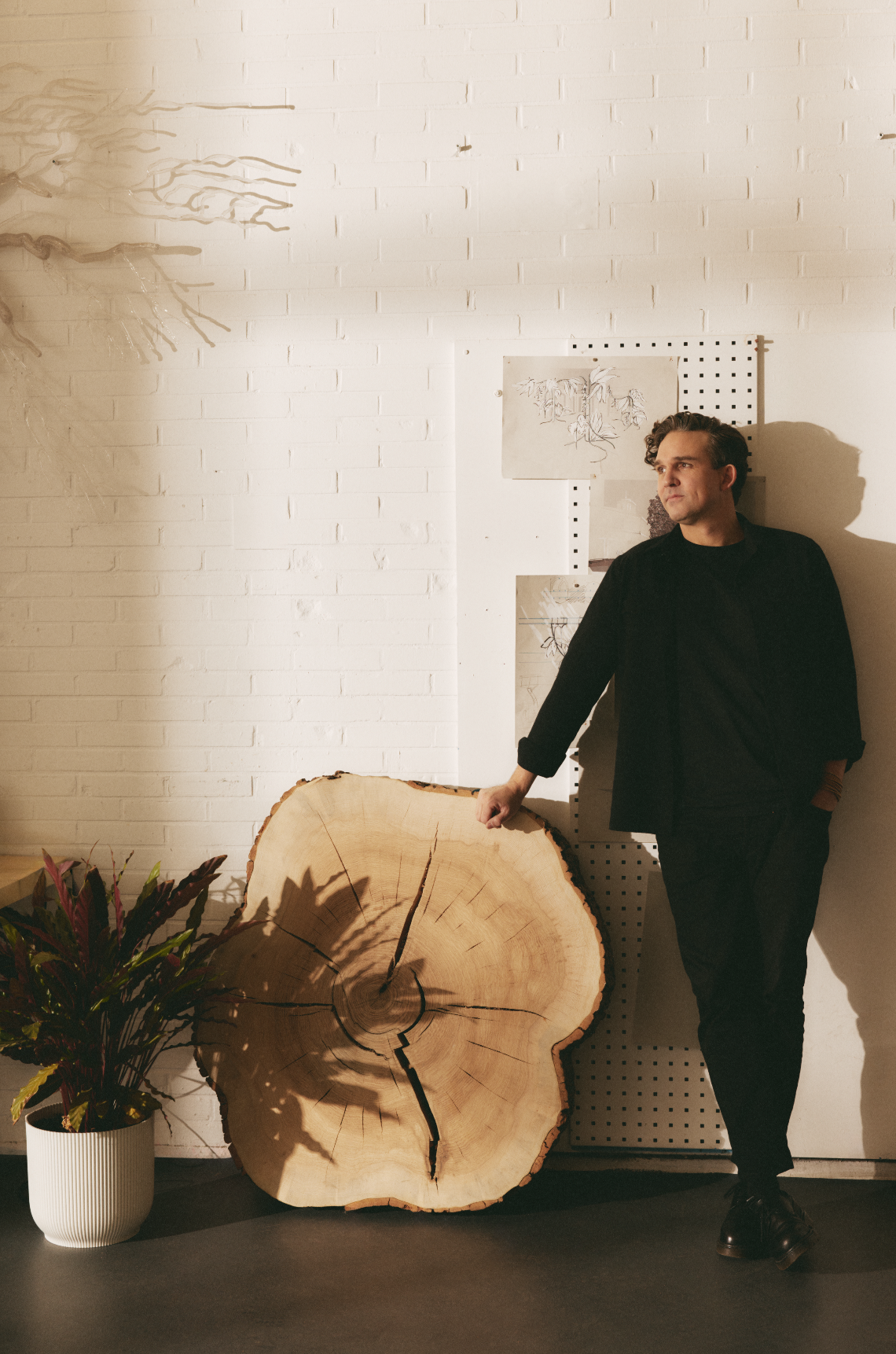
As an ecological artist I collaborate with leading scientists to create eco data-driven artworks that translate complex scientific environmental research into immersive installations and experiences.
I am also the founder of Woven, where my team and I unite art and science under one mission: making complex environmental issues accessible, understandable, and personal, ensuring that science reaches both the heads of state and the hearts of the public.
All of my work is rooted in scientific collaboration with partners like UNESCO, WHO, LVMH, Ruinart, Polestar, and the Natural History Museum London. Exhibited at Fondation Cartier, the Barbican Centre, the Stedelijk Museum, Art Basel, and Tefaf, and featured on global platforms including COP, the United Nations, and the Montreux Jazz Festival. Three TED Talks, a UN keynote, and World Economic Forum Cultural Leader.
Visit thijsbiersteker.com →Invasiva is a data driven sculpture in collaboration with the team of Fauna & Flora and IUCN. The team of WOVEN under the lead of the artist Thijs Biersteker created a mapping of the costs and impact of invasive alien species by combining datasets that update as we go.
Invasive species are responsible for 60 percent of recorded extinctions and cost the global economy more than $423 billion every year, yet remain one of the few biodiversity crises where action is genuinely possible.
Switch to economical and ecological impact of invasive species.
Global distribution mapped by economic impact and species threat level, interactive taxonomy deep-dive by region.
Fauna & Flora is the world's oldest international wildlife conservation organisation, founded in 1903. They work in more than 40 countries, protecting threatened species alongside the communities that live with them.
The IUCN sets the global framework for invasive species. Together they shaped the science behind Invasiva.
Invasive alien species are pushing native life out of ecosystems worldwide. This module puts that crisis in your hands.
Read the data. Watch the Invasive Sphere grow. Shrink it back only when you understand the science well enough to fight back.
We help science reach the heads of state and the hearts of the public by harnessing the emotional power of art and culture.
Visit website →Fauna & Flora is one of the world's oldest international wildlife conservation charities, founded over 120 years ago and today working with partners in more than 40 countries.
Visit website →IUCN (International Union for Conservation of Nature) is a membership Union of government and civil society organisations. Together, we work to advance sustainable development and create a just world that values and conserves nature.
Visit website →The Villars Institute is a nonprofit foundation based in the Swiss Alps dedicated to accelerating the transition to net zero emissions and a healthier planet through intergenerational collaboration and systems leadership.
Visit website →The World Biodiversity Forum brings together researchers, practitioners and societal actors across generations to advance equitable and just solutions to halt and reverse biodiversity loss. WBF2026: Davos, 14 to 19 June 2026, theme Leading Transformation Together.
Visit website →